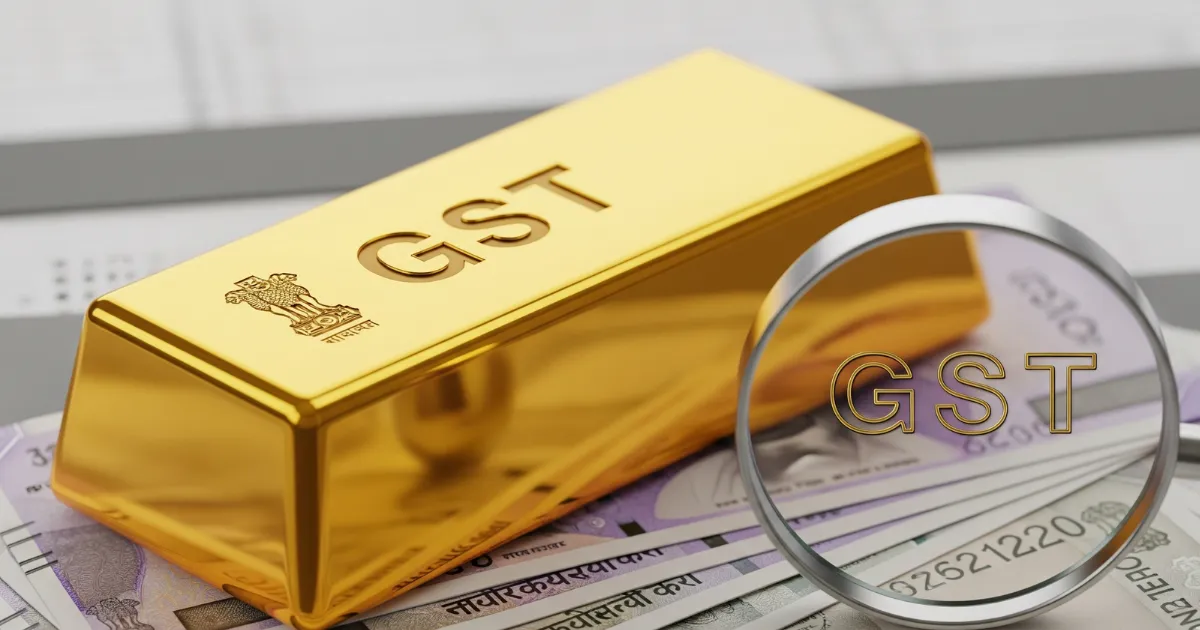
GST on Gold 2025: Gold has always been a cornerstone of investment in India, cherished not just for its cultural significance but also for its financial stability. However, the introduction of the Goods and Services Tax (GST) in 2017 transformed how gold is taxed, impacting buyers, investors, and jewellers alike. As we step into 2025, understanding GST on Gold 2025 is crucial for making informed investment decisions. Are you paying more than you should? Could upcoming GST changes affect your gold investments?
This article uncovers five surprising facts about GST on Gold 2025 that every investor must know to navigate the market effectively. From tax structures to potential reforms, we’ll break it all down in a clear, engaging way to help you stay ahead.
Understanding GST on Gold: The Basics
Contents
- 1 Understanding GST on Gold: The Basics
- 2 Fact 1: GST Reforms in 2025 Could Lower Gold Prices
- 3 Fact 2: Digital Gold Offers a GST Advantage
- 4 Fact 3: Customs Duty Cuts Have a Bigger Impact Than GST
- 5 Fact 4: Input Tax Credit (ITC) Benefits Jewellers, Not Retail Buyers
- 6 Fact 5: Gold ETFs and Sovereign Gold Bonds Are GST-Free Alternatives
- 7 How to Navigate GST on Gold in 2025
- 8 FAQ Section
- 8.1 1: What is the GST rate on gold in India in 2025?
- 8.2 2: How does GST on gold affect jewellery prices compared to coins or bars?
- 8.3 3: Can investors claim Input Tax Credit (ITC) on GST paid for gold?
- 8.4 4: How do customs duty changes in 2025 impact GST on gold?
- 8.5 5: Are there GST-free gold investment options in 2025?
- 8.6 6: Will GST on gold change before Diwali 2025?
- 9 Conclusion
Before diving into the surprises, let’s clarify how GST on Gold works in India. The Goods and Services Tax, implemented in 2017, replaced a fragmented system of VAT, excise duty, and service tax with a unified tax structure. For gold, the GST rate is 3% on the value of the metal, whether it’s 18K, 22K, or 24K gold, coins, bars, or jewellery. Additionally, a 5% GST applies to making charges for jewellery, covering craftsmanship costs. This dual taxation affects the final price you pay at the counter.
For example, if you buy a 22K gold necklace worth ₹1,00,000 with ₹10,000 in making charges, the GST calculation would be:
- Gold Value GST: ₹1,00,000 × 3% = ₹3,000
- Making Charges GST: ₹10,000 × 5% = ₹500
- Total GST: ₹3,500
- Final Price: ₹1,13,500 (including GST)
This structure, while transparent, has raised costs compared to pre-GST days, where taxes were around 1–2%. Let’s explore five surprising facts about GST on Gold 2025 that could reshape your investment strategy.
Fact 1: GST Reforms in 2025 Could Lower Gold Prices
One of the most exciting developments for gold investors in 2025 is the potential for GST reforms. The GST Council’s “GST 2.0” initiative, announced in September 2025, aims to simplify tax slabs, moving most items to either 5% or 18% rates. While the GST on gold remains at 3% as of September 2025, major jewellery associations like Malabar Gold & Diamonds and the Gems and Jewellery Council (GJC) are advocating for a reduction to 1%. This could significantly lower the cost of gold purchases, especially during the festive season like Diwali.
Why This Matters
A reduction from 3% to 1% GST could save buyers thousands. For instance:
- On a ₹5,00,000 gold purchase, a 3% GST equals ₹15,000.
- At 1% GST, the tax drops to ₹5,000, saving ₹10,000.
Real-World Example
Ravi, a Mumbai-based investor, plans to buy 50 grams of gold for his daughter’s wedding. At ₹8,000 per gram, the gold costs ₹4,00,000. With 3% GST, he pays ₹12,000 in tax. If the GST drops to 1%, his tax would be ₹4,000, saving him ₹8,000—enough to cover additional making charges or a small piece of jewellery.
What to Watch
Keep an eye on GST Council meetings, especially post-September 2025, for updates on rate rationalization. A lower GST could boost demand, potentially increasing gold prices due to market dynamics. Check trusted sources like ClearTax for real-time GST updates.
Fact 2: Digital Gold Offers a GST Advantage
Digital gold, offered by platforms like Dhan and Gullak, is gaining traction among investors due to its convenience and cost efficiency. Unlike physical jewellery, digital gold attracts only 3% GST on its value, with no additional making charges. This makes it a compelling option for investors focused on pure gold value rather than ornamental designs.
How Digital Gold Works
Digital gold allows you to buy, sell, and hold gold electronically without physical storage. Platforms like Gullak Gold+ even offer schemes to offset GST costs:
- Extra 5% Plan: Investors receive an additional 5% gold annually, mitigating the 3% GST impact over time.
- GST Waive-Off Plan: Offers 2% extra gold in the first year and 5% thereafter, with a one-year lock-in.
Case Study: Priya’s Investment
Priya, a 30-year-old professional, invests ₹1,00,000 in digital gold. She pays ₹3,000 GST (3%). With Gullak’s 5% extra gold plan, she gains an additional 5 grams of gold (worth ₹4,000 at ₹8,000/gram) annually, effectively offsetting the GST and boosting her returns. Over five years, her gold quantity grows significantly, unlike physical jewellery, which incurs additional making charges.
Why It’s Surprising
Many investors overlook digital gold, assuming it’s less “tangible.” However, its GST advantage and flexibility make it ideal for long-term wealth creation. Explore platforms like Dhan for digital gold options.
Fact 3: Customs Duty Cuts Have a Bigger Impact Than GST
In the Union Budget 2024, the Indian government slashed customs duties on gold from 15% to 6%, reducing the Basic Customs Duty (BCD) from 10% to 5% and the Agriculture Infrastructure and Development Cess (AIDC) from 5% to 1%. This change, effective July 2024, lowered domestic gold prices significantly, overshadowing the 3% GST impact.
How It Affects Investors
Lower customs duties reduce the landed cost of imported gold, which constitutes a significant portion of India’s supply. For example:
- Pre-July 2024: A ₹1,00,000 gold purchase included ~₹15,000 in customs duty + ₹3,000 GST = ₹18,000 in taxes.
- Post-July 2024: The same purchase incurs ~₹6,000 in customs duty + ₹3,000 GST = ₹9,000 in taxes.
This 9% reduction makes gold more affordable, boosting demand, especially during festive seasons.
Real-World Impact
In July 2025, gold imports surged from $1.8 billion to $4 billion, reflecting strong demand post-duty cuts. Investors like Anjali, who bought 20 grams of gold coins, saved nearly ₹18,000 compared to 2023 prices, making her investment more cost-effective.
Why It’s Surprising
Many investors focus solely on GST, but customs duties have a larger impact on final prices. Staying informed via sources like MMTC-PAMP can help you time purchases during price dips.
Fact 4: Input Tax Credit (ITC) Benefits Jewellers, Not Retail Buyers
A lesser-known aspect of GST on Gold 2025 is the Input Tax Credit (ITC). Registered jewellers and gold merchants can claim ITC on GST paid for raw materials, job work, or reverse charge supplies from unregistered workers. This reduces their tax liability, but retail buyers cannot claim ITC, increasing their costs.
How ITC Works
- A jeweller buys raw gold worth ₹10,00,000, paying ₹30,000 GST (3%).
- They claim this ₹30,000 as ITC when filing GST returns, offsetting taxes on sales.
- Retail buyers, however, pay the full 3% GST + 5% on making charges without ITC eligibility.
Example: Sanjay’s Jewellery Business
Sanjay, a Delhi-based jeweller, purchases ₹50,00,000 worth of gold annually. He pays ₹1,50,000 GST, which he claims as ITC. This allows him to price his jewellery competitively. However, his customers, like Meera, pay ₹3,000 GST on a ₹1,00,000 necklace without any refund, making gold slightly costlier for retail investors.
Why It’s Surprising
Many investors assume GST benefits apply universally, but ITC is exclusive to businesses. To save costs, consider buying BIS-hallmarked gold coins or bars, which often have lower or no making charges. Check compliance tips at IndiaFilings.
Fact 5: Gold ETFs and Sovereign Gold Bonds Are GST-Free Alternatives
Gold Exchange-Traded Funds (ETFs) and Sovereign Gold Bonds (SGBs) offer GST-free investment options, making them attractive for savvy investors. While physical gold incurs 3% GST, these instruments are exempt, though ETFs may attract 18% GST on management fees, and SGBs incur 18% GST on brokerage fees.
Comparing Investment Options
| Investment Type | GST Applicability | Other Taxes | Best For |
|---|---|---|---|
| Physical Gold | 3% on value + 5% on making charges | Customs duty (6%) | Traditional buyers, jewellery lovers |
| Digital Gold | 3% on value | Capital gains tax | Investors seeking convenience |
| Gold ETFs | No GST on units, 18% on management fees | Capital gains tax, STT | Long-term investors |
| Sovereign Gold Bonds | No GST on bonds, 18% on brokerage | Capital gains tax on interest | Risk-averse investors |
Case Study: Vikram’s Portfolio
Vikram, a Bengaluru-based investor, allocates ₹2,00,000 to gold. He splits his investment:
- ₹1,00,000 in SGBs: No GST, only ₹180 brokerage GST (assuming 0.1% brokerage).
- ₹1,00,000 in Gold ETFs: No GST on units, ₹1,800 GST on 1% management fees annually. Compared to physical gold (₹3,000 GST + ₹500 making charges), Vikram saves significantly, with added liquidity and no storage costs.
Why It’s Surprising
Many investors are unaware that GST-free options like ETFs and SGBs can outperform physical gold in tax efficiency. Learn more about SGBs at Bajaj Finance.
To make the most of your gold investments in 2025, consider these tips:
- Check for GST Updates: Monitor GST Council announcements for potential rate cuts, especially before festive seasons.
- Buy BIS-Hallmarked Gold: Ensure purity and resale value with certified gold.
- Compare Charges: Negotiate making charges (3–25%) to reduce GST impact.
- Explore Alternatives: Digital gold, ETFs, or SGBs can save on taxes and offer flexibility.
- Demand Itemized Invoices: Ensure transparency in GST and making charges.
FAQ Section
1: What is the GST rate on gold in India in 2025?
The GST rate on gold in India in 2025 is 3% on the value of gold, applicable to all forms like jewellery, coins, and bars. Additionally, a 5% GST applies to making charges for jewellery. For example, if you buy a gold bar worth ₹1,00,000, you pay ₹3,000 GST. For jewellery with ₹10,000 making charges, you pay an extra ₹500 GST. This rate, unchanged since 2017, replaced the earlier 1–2% VAT and service tax, making pricing uniform but slightly costlier. Investors should check for potential GST reductions, as the GST Council is discussing a 1% rate, which could lower costs significantly. Always demand an itemized invoice to verify GST calculations.
2: How does GST on gold affect jewellery prices compared to coins or bars?
GST on gold jewellery includes 3% on the gold value and 5% on making charges, which range from 3–25% of the gold’s value. For coins and bars, only the 3% GST applies, as they typically have no making charges. For instance, a ₹1,00,000 gold necklace with 10% making charges incurs ₹3,000 (gold GST) + ₹500 (making charges GST) = ₹3,500 total GST. A ₹1,00,000 gold coin incurs only ₹3,000 GST. This makes coins and bars cheaper for investment purposes. Buyers should compare making charges across jewellers and opt for BIS-hallmarked products to ensure purity and value.
3: Can investors claim Input Tax Credit (ITC) on GST paid for gold?
Retail investors cannot claim Input Tax Credit (ITC) on GST paid for gold purchases, as ITC is available only to GST-registered businesses using gold for commercial purposes. For example, a jeweller buying ₹10,00,000 worth of gold pays ₹30,000 GST, which they can claim as ITC when filing returns. Retail buyers, however, bear the full 3% GST (plus 5% on making charges for jewellery) without refunds. To minimize costs, consider digital gold or GST-free options like Sovereign Gold Bonds, which avoid additional taxes. Always maintain invoices for transparency and compliance.
4: How do customs duty changes in 2025 impact GST on gold?
The Union Budget 2024 reduced customs duties on gold from 15% to 6%, lowering the overall tax burden (customs duty + GST) from ~18% to ~9%. While GST on Gold 2025 remains 3%, the duty cut reduces the base price of imported gold, indirectly lowering the GST amount. For example, on a ₹1,00,000 gold purchase pre-2024, taxes were ₹15,000 (customs) + ₹3,000 (GST) = ₹18,000. Post-2024, it’s ₹6,000 (customs) + ₹3,000 (GST) = ₹9,000. This makes gold more affordable, boosting demand. Monitor global gold prices via World Gold Council for strategic buying.
5: Are there GST-free gold investment options in 2025?
Yes, Gold ETFs and Sovereign Gold Bonds (SGBs) are GST-free alternatives. ETFs incur no GST on units, only 18% on management fees, while SGBs have no GST on the bond itself, only 18% on brokerage fees. For example, investing ₹1,00,000 in SGBs incurs ~₹180 brokerage GST versus ₹3,000 GST on physical gold. These options offer liquidity, no storage costs, and tax efficiency, ideal for long-term investors. Digital gold, while subject to 3% GST, avoids making charges. Explore these options on platforms like Razorpay for cost-effective investing.
6: Will GST on gold change before Diwali 2025?
As of September 2025, the GST on gold remains 3%, with no confirmed changes before Diwali. However, Prime Minister Narendra Modi’s announcement of a GST revamp and the GST Council’s “GST 2.0” initiative have raised hopes for a reduction to 1%. This could lower costs by ₹2,000–₹10,000 on purchases worth ₹1,00,000–₹5,00,000. Investors should monitor updates from sources like BuddyLoan and time purchases during festive sales to maximize savings. Buying BIS-hallmarked gold ensures purity and resale value, regardless of tax changes.
Conclusion
Navigating GST on Gold 2025 requires understanding its nuances and staying updated on potential reforms. From the possibility of a GST rate cut to the advantages of digital gold and GST-free options like ETFs and SGBs, these five surprising facts empower you to make smarter investment choices. The 2024 customs duty reduction has already made gold more affordable, and platforms like Gullak and Dhan offer innovative ways to offset GST costs. Whether you’re buying jewellery for a wedding or investing for the future, always demand itemized invoices, check for BIS hallmarks, and explore tax-efficient alternatives.
Have you adjusted your gold investment strategy for 2025? Share your thoughts in the comments below, or subscribe to our newsletter for the latest market updates and investment tips!