Infosys Rs 18000 Crore Share Buyback 2025: Are you an investor wondering how the Infosys Rs. 18000 Crore Share Buyback 2025 impacts your portfolio? With India’s second-largest IT services company announcing its largest-ever share repurchase program, the financial world is abuzz. This monumental move has sparked debates: Is this Infosys’ boldest investor reward yet, or a strategic play to stabilize its stock amidst market challenges? In this comprehensive article, we dive deep into the details of the buyback, its implications for shareholders, and what it signals about Infosys’ financial strategy. Packed with data, expert insights, and practical takeaways, this guide will help you understand whether this buyback is a golden opportunity or a cautious maneuver.
Contents
- 1 What Is the Infosys Rs 18000 Crore Share Buyback 2025?
- 2 Infosys’ Buyback History: A Pattern of Shareholder Rewards
- 3 Infosys Rs 18000 Crore Share Buyback 2025: Why Is Infosys Pursuing This Buyback?
- 4 Infosys Rs 18000 Crore Share Buyback 2025: How Does the Buyback Impact Shareholders?
- 5 Infosys Rs 18000 Crore Share Buyback 2025: Analyst Perspectives and Market Reactions
- 6 Comparison with Peer Buybacks
- 7 Infosys Rs 18000 Crore Share Buyback 2025: Regulatory and Procedural Details
- 8 Strategic Implications for Infosys
- 9 FAQs About Infosys Rs 18000 Crore Share Buyback 2025
- 9.1 1. What is the Infosys Rs 18000 Crore Share Buyback 2025?
- 9.2 2. Why is Infosys conducting this buyback?
- 9.3 3. How will the buyback affect Infosys shareholders?
- 9.4 4. What is the difference between tender offer and open market buybacks?
- 9.5 5. Will the buyback guarantee a stock price increase?
- 9.6 6. How does Infosys’ buyback compare to TCS and Wipro?
- 9.7 7. Should investors participate in the buyback?
- 10 Conclusion
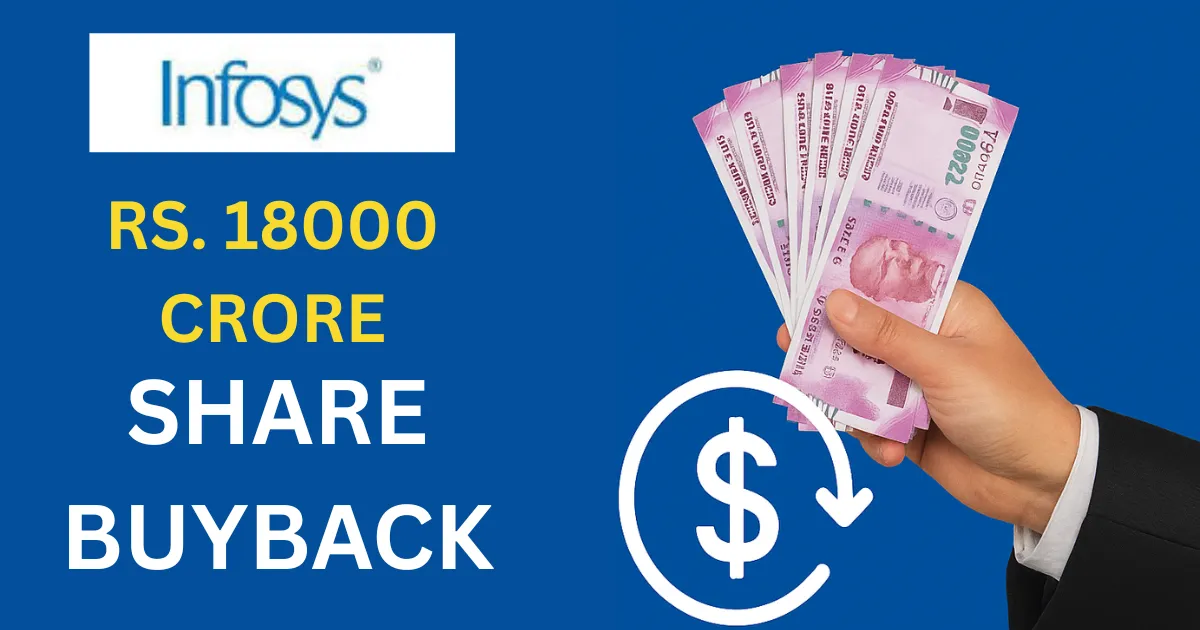
On September 11, 2025, Infosys, headquartered in Bengaluru, announced a Rs. 18,000 crore share buyback—its fifth since 2017 and the largest in its history. The company plans to repurchase up to 10 crore fully paid-up equity shares at Rs. 1,800 per share, reflecting a 19% premium over the closing price of Rs. 1,512.20 on September 11, 2025. This buyback, executed via the tender offer route, represents 2.41% of Infosys’ paid-up equity capital and is subject to shareholder approval through a postal ballot.
A share buyback occurs when a company repurchases its own shares from the market, reducing the number of outstanding shares. This can:
- Boost Earnings Per Share (EPS): Fewer shares mean higher EPS, improving financial metrics.
- Signal Confidence: It reflects management’s belief in strong future cash flows.
- Optimize Capital Structure: Excess cash is returned to shareholders tax-efficiently.
- Support Stock Price: Buybacks can stabilize or boost share prices during volatility.
For Infosys, this move comes after a 22% decline in share price over the past year, making it a critical step to restore investor confidence.
Infosys has a robust history of rewarding shareholders through buybacks and dividends. Since 2017, the company has executed four buybacks, cumulatively returning Rs. 39,760 crore to shareholders. The 2025 buyback pushes this total to Rs. 57,760 crore. Here’s a snapshot of past buybacks:
| Year | Buyback Size (Rs. Crore) | Shares Repurchased (Crore) | Price Per Share (Rs.) | Premium (%) | Route |
|---|---|---|---|---|---|
| 2017 | 13,000 | 11.30 | 1,150 | 25% | Tender |
| 2019 | 8,260 | 11.05 | 747 | 18% | Open Market |
| 2021 | 9,200 | 5.58 | 1,750 | 25% | Open Market |
| 2022 | 9,300 | 6.04 | 1,539 | 30% | Open Market |
| 2025 | 18,000 | 10.00 | 1,800 | 19% | Tender |
Key Observations
- Largest Buyback Yet: The 2025 buyback matches the scale of TCS’s 2022 Rs. 18,000 crore repurchase, signaling Infosys’ aggressive capital allocation strategy.
- Tender Offer Route: Unlike the last three buybacks, which used open market purchases, the 2025 buyback adopts the tender offer route, ensuring a fixed price and premium for shareholders.
- Historical Impact: Post-buyback announcements, Infosys shares have historically gained 3–22% over 3–6 months, though short-term volatility is common.
The Infosys Rs. 18000 Crore Share Buyback 2025 is driven by multiple strategic objectives, reflecting the company’s financial strength and market positioning.
1. Strong Financial Position
Infosys boasts a robust balance sheet, with over Rs. 40,000 crore in cash and liquid investments and Rs. 30,000 crore in annual free cash flow as of June 2025. This financial firepower allows the company to return capital to shareholders while investing in growth areas like AI and cloud computing.
2. Countering Stock Price Decline
Infosys’ stock has underperformed in 2025, falling 18% year-to-date compared to a 3.72% gain in the BSE Sensex. The broader Nifty IT Index has also declined by 17%, reflecting global uncertainties and U.S. trade tariff concerns. The buyback aims to stabilize the stock price and signal confidence amid these headwinds.
3. Enhancing Financial Metrics
By reducing the number of outstanding shares, Infosys expects to boost EPS by 3–5%, according to fund manager Akshay Badjate of Merisis PMS. This also improves Return on Equity (ROE), making the stock more attractive to investors.
4. Tax-Efficient Returns
Buybacks offer a tax-efficient way to return capital compared to dividends, especially for high-net-worth investors. The 19% premium ensures shareholders receive a significant payout, enhancing investor sentiment.
The Infosys Rs. 18000 Crore Share Buyback 2025 has far-reaching implications for its 26 lakh shareholders. Here’s a breakdown:
- Immediate Returns: Shareholders tendering their shares at Rs. 1,800 receive a 19% premium, providing a lucrative exit option.
- Long-Term Gains: Reduced share count boosts EPS, potentially driving stock price appreciation.
- Arbitrage Opportunities: Investors can buy shares at the current market price (around Rs. 1,539 as of September 12, 2025) and tender them for a profit.
- Confidence Boost: The buyback signals management’s optimism, countering negative sentiment from FII outflows (Rs. 19,901 crore in July and Rs. 11,285 crore in August).
Risks to Consider
- Short-Term Volatility: Historical data shows Infosys’ stock fell 7% in the first month after the 2017 buyback, though it rebounded later.
- Macro Uncertainties: Global economic challenges and tariff risks could limit stock price gains.
- Opportunity Cost: Funds used for the buyback may reduce investments in high-growth areas like AI or acquisitions.
Brokerages have largely welcomed the Infosys Rs. 18000 Crore Share Buyback 2025, with several issuing bullish outlooks:
| Brokerage | Rating | Target Price (Rs.) | Key Insight |
|---|---|---|---|
| Jefferies | Buy | 1,660 | Buyback supports EPS growth and stock stability. |
| Nomura | Buy | 1,880 | Attractive risk-reward at current valuations. |
| Morgan Stanley | Equal Weight | 1,700 | Signals confidence amid macro uncertainties. |
Market Response
On September 12, 2025, Infosys shares surged over 2% to Rs. 1,539.90 in early trading, adding approximately Rs. 40,000 crore to its market capitalization since the buyback announcement on September 8. The Nifty IT Index also gained traction, reflecting optimism in the sector.
Comparison with Peer Buybacks
To contextualize the Infosys Rs. 18000 Crore Share Buyback 2025, let’s compare it with major buybacks by peers like TCS and Wipro:
| Company | Year | Buyback Size (Rs. Crore) | Shares Repurchased (Crore) | Price Per Share (Rs.) | Premium (%) |
|---|---|---|---|---|---|
| Infosys | 2025 | 18,000 | 10.00 | 1,800 | 19% |
| TCS | 2022 | 18,000 | 4.00 | 4,500 | 20% |
| Wipro | 2020 | 9,500 | 23.75 | 400 | 15% |
Key Takeaways
- Scale: Infosys’ buyback matches TCS’s 2022 record, signaling a competitive stance in the IT sector.
- Premium: Infosys’ 19% premium is comparable to TCS’s 20%, but higher than Wipro’s 15%.
- Route: Infosys’ shift to the tender offer route aligns with TCS’s strategy, ensuring a fixed payout for shareholders.
Analysts speculate that TCS and Wipro may announce buybacks soon, given their eligibility and the sector’s need to counter stock price declines.
The Infosys Rs. 18000 Crore Share Buyback 2025 complies with Indian regulations, ensuring the buyback size does not exceed 25% of the aggregate paid-up capital and free reserves as of June 30, 2025. Additionally, Infosys secured exemptive relief from the U.S. SEC to align tender offer procedures with Indian regulations, facilitating participation by U.S.-listed ADR holders.
Next Steps
- Shareholder Approval: Infosys will seek approval via a postal ballot, with details on timelines and record dates to be announced.
- Public Announcement: Statutory documents outlining the process will be released soon.
- Execution: The tender offer will allow shareholders to submit shares at Rs. 1,800, with acceptance based on proportional allocation.
Strategic Implications for Infosys
The buyback reflects Infosys’ dual focus on rewarding shareholders and positioning for future growth. With Rs. 42,000 crore in cash and cash equivalents and a 7.53% revenue increase in Q1 FY26 (Rs. 42,279 crore), Infosys is well-equipped to navigate challenges while investing in emerging technologies.
Balancing Act
- Innovation Investments: Infosys continues to prioritize AI, cloud, and digital transformation, ensuring long-term competitiveness.
- Capital Allocation: The company has returned 85% of free cash flow (Rs. 88,400 crore) between FY20–24 through dividends and buybacks, maintaining a balanced approach.
- Market Sentiment: The buyback counters negative sentiment from FII selling and global uncertainties, reinforcing Infosys’ stability.
Internal Links:
External Links:
The Infosys Rs 18000 Crore Share Buyback 2025 is a program announced on September 11, 2025, where Infosys will repurchase up to 10 crore equity shares at Rs. 1,800 per share, totaling Rs. 18,000 crore. This represents 2.41% of its paid-up equity capital and is executed via the tender offer route, offering a 19% premium over the market price. It’s the largest buyback in Infosys’ history, aimed at boosting EPS, optimizing capital, and signaling confidence in future growth. Shareholders must approve the plan via a postal ballot, with further details on timelines pending.
2. Why is Infosys conducting this buyback?
Infosys is pursuing the buyback to address multiple objectives. First, its 22% stock price decline in 2025 necessitates action to stabilize valuations. Second, with over Rs. 40,000 crore in cash, Infosys can afford to return capital while investing in growth. Third, the buyback enhances EPS by 3–5% and improves ROE, making the stock more attractive. Finally, it offers tax-efficient returns compared to dividends, especially amid FII outflows of Rs. 31,186 crore in July–August 2025. The move signals management’s confidence despite global economic challenges.
Shareholders benefit from the 19% premium offered at Rs. 1,800 per share, providing immediate returns for those who tender shares. The reduced share count boosts EPS, potentially driving long-term stock price gains. Arbitrage opportunities exist for investors buying at current prices (around Rs. 1,539) to tender later. However, short-term volatility is possible, as seen in the 7% drop post-2017 buyback. Macro uncertainties, like U.S. tariffs, may also limit gains. Overall, the buyback enhances investor confidence and supports valuations for Infosys’ 26 lakh shareholders.
4. What is the difference between tender offer and open market buybacks?
A tender offer buyback, like the Infosys Rs 18000 Crore Share Buyback 2025, involves repurchasing shares at a fixed price (Rs. 1,800) with a set premium (19%), directly from shareholders who choose to participate. It ensures a guaranteed payout but requires shareholder approval. An open market buyback, used in Infosys’ 2019–2022 programs, involves buying shares from the stock exchange at prevailing market prices, offering flexibility but no fixed premium. Tender offers are more shareholder-friendly, while open market purchases allow companies to time purchases strategically.
5. Will the buyback guarantee a stock price increase?
No buyback guarantees a stock price increase. While the Infosys Rs 18000 Crore Share Buyback 2025 has driven a 2% stock surge on September 12, 2025, and historical buybacks show 3–22% gains over 3–6 months, short-term volatility is common. For instance, the 2017 buyback saw a 7% drop initially. Factors like global economic conditions, FII selling, and tariff uncertainties could cap gains. However, the buyback’s EPS boost and management’s confidence signal positive long-term potential, making it a “buy on dips” candidate, per analysts.
6. How does Infosys’ buyback compare to TCS and Wipro?
Infosys’ Rs. 18,000 crore buyback matches TCS’s 2022 buyback of Rs. 18,000 crore at Rs. 4,500 per share (20% premium) but surpasses Wipro’s 2020 buyback of Rs. 9,500 crore at Rs. 400 per share (15% premium). Infosys’ 2.41% equity repurchase is smaller than TCS’s 4% but larger than Wipro’s 1.19%. Infosys’ shift to the tender offer route aligns with TCS’s strategy, ensuring a fixed payout. Analysts expect TCS and Wipro to follow with buybacks, given their 24% and 16% stock declines in 2025.
7. Should investors participate in the buyback?
Deciding to participate in the Infosys Rs 18000 Crore Share Buyback 2025 depends on your investment goals. Short-term investors can benefit from the 19% premium by tendering shares, especially if purchased at current prices (around Rs. 1,539). Long-term investors may prefer holding, as the EPS boost and historical 3–22% gains post-buyback suggest upside potential. However, risks include short-term volatility and macro uncertainties. Consult a financial advisor to align the decision with your portfolio strategy, considering Infosys’ strong balance sheet and growth prospects in AI and cloud computing.
Conclusion
The Infosys Rs 18000 Crore Share Buyback 2025 is a landmark move, signaling confidence in the company’s financial health and long-term prospects. By offering a 19% premium and repurchasing 2.41% of its equity, Infosys aims to boost EPS, stabilize its stock price, and reward its 26 lakh shareholders. While historical buybacks show promising gains, investors must weigh short-term volatility and global uncertainties. With a robust balance sheet and strategic focus on emerging technologies, Infosys is well-positioned for growth. What are your thoughts on this buyback? Share your insights in the comments or subscribe to our newsletter for more market updates!