Tata Motors Demerger 2025: The long-awaited Tata Motors demerger is finally set to take effect in October 2025, and the development has created a wave of excitement across Dalal Street. Investors, analysts, and market observers are closely watching how this restructuring will reshape the automobile giant and what it means for shareholders.
Tata Motors has been a diversified powerhouse, balancing its passenger vehicles, electric mobility, commercial vehicles, and Jaguar Land Rover (JLR) businesses under one umbrella. While this helped it maintain stability, investors often argued that the true value of its EV business or the global JLR arm wasn’t fully reflected in the share price. The demerger aims to change that.
So, what comes next for shareholders after this restructuring, and what price trends should you keep an eye on? Let’s break it down.
Why Tata Motors Chose Demerger in 2025
Contents
- 1 Why Tata Motors Chose Demerger in 2025
- 2 Tata Motors Demerger 2025 – Post-Split Structure
- 3 What Next for Shareholders After Demerger?
- 4 Tata Motors Price Trends: Pre vs Post Demerger
- 5 Why Analysts See Big Potential
- 6 Risks That Cannot Be Ignored
- 7 FAQs on Tata Motors Demerger 2025
- 7.0.1 Q1. What is the Tata Motors demerger 2025 about?
- 7.0.2 Q2. When is the Tata Motors demerger effective?
- 7.0.3 Q3. How will Tata Motors shareholders be affected?
- 7.0.4 Q4. Why did Tata Motors decide to demerge?
- 7.0.5 Q5. Will the Tata Motors share price rise after demerger?
- 7.0.6 Q6. What are the risks of the Tata Motors demerger?
- 7.0.7 Q7. Should investors hold or sell after the Tata Motors demerger?
- 8 Conclusion
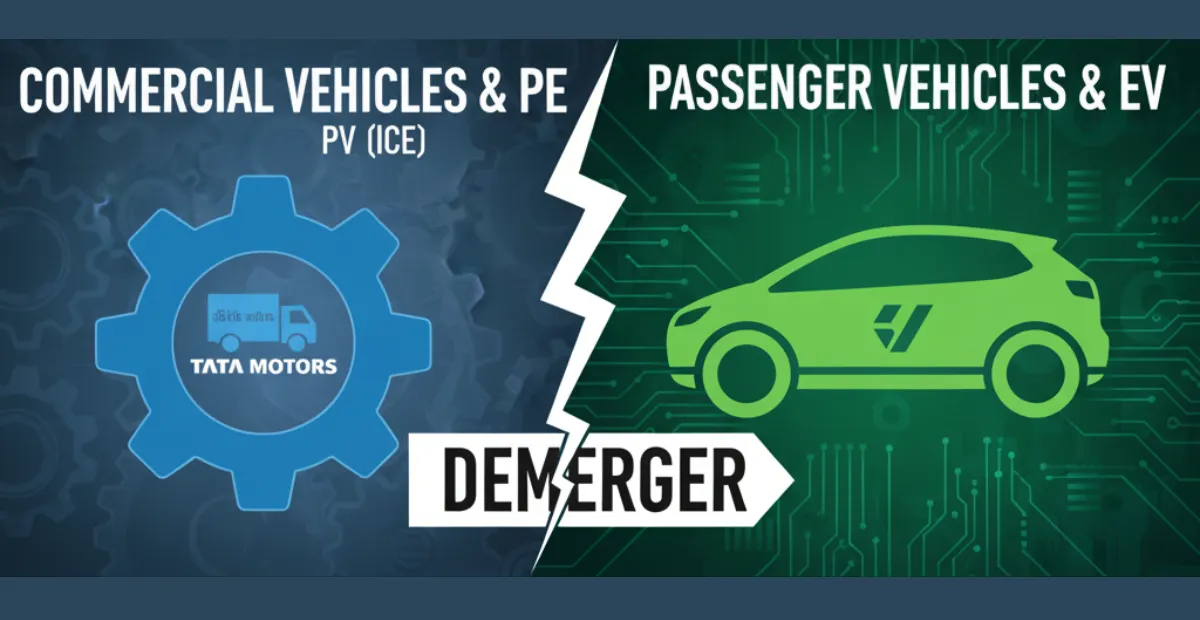
The idea behind the demerger is simple: unlock value. By splitting businesses into focused verticals, Tata Motors is giving each unit more operational independence and visibility. Investors will now be able to analyze and value passenger vehicles (including EVs), commercial vehicles, and JLR separately.
This strategy is not new — global giants like General Motors and Volkswagen have also pursued similar restructuring to highlight specific business strengths. For Tata Motors, the timing is ideal as India’s automobile industry is witnessing a rapid transformation led by electric vehicles and commercial vehicle recovery.
Tata Motors Demerger 2025 – Post-Split Structure
Here’s how Tata Motors will look post-demerger and what shareholders can expect in terms of business distribution:
| Particulars | Details |
|---|---|
| Demerger Effective Date | October 1, 2025 |
| Parent Company | Tata Motors Ltd. |
| New Structure | (1) Passenger Vehicles + EV Business (2) Commercial Vehicles (3) Jaguar Land Rover (separate reporting unit) |
| Shareholding Impact | Shareholders of Tata Motors will receive proportionate shares in the demerged entities (swap ratio to be officially declared). |
| Listing Platforms | BSE & NSE |
| Strategic Goals | Unlock hidden value, improve business focus, and attract targeted investors. |
| Key Value Drivers | EV adoption in India, JLR global sales momentum, and CV industry revival. |
This clear separation gives investors the freedom to focus on segments that align with their strategies — whether it’s India’s booming EV market, commercial vehicle growth, or JLR’s premium car performance abroad.
If you already own Tata Motors shares, you don’t need to take any additional action. Your existing holding will automatically be split proportionately across the new entities. The real question is: Should you hold, sell, or add more after the demerger?
- For Long-Term Investors: The EV and passenger vehicle business could be a major wealth creator over the next decade as India transitions to cleaner mobility. Holding could unlock substantial value.
- For Value Seekers: Commercial vehicles, though cyclical, benefit directly from India’s infrastructure growth. If valuations remain attractive, it could be a strong bet.
- For Global Exposure: JLR continues to be a key profit driver. For those seeking international diversification, it remains a valuable part of the portfolio.
Essentially, the demerger gives you the flexibility to decide which business you want to hold for the long term, instead of being tied to a bundled valuation.
Tata Motors Price Trends: Pre vs Post Demerger
Tata Motors shares have been in focus ever since the demerger announcement was made. Analysts expect short-term volatility as markets adjust, but the long-term trend remains bullish.
| Period | Price Trend Expectation |
|---|---|
| Pre-Demerger (Sept 2025) | Stock saw a rally due to excitement around value unlocking. |
| Listing Week (Oct 2025) | Volatility likely as investors adjust to new entities and swap ratios. |
| 3–6 Months Post Demerger | Re-rating expected, especially for EV and passenger vehicle arm. |
| 1–2 Years Outlook | Steady upward trend if EV adoption grows and JLR maintains global sales. |
Experts believe that the combined market capitalization of the demerged entities could surpass Tata Motors’ current valuation. This re-rating opportunity is what excites most investors.
Why Analysts See Big Potential
There are strong reasons why market experts are optimistic about Tata Motors post-demerger:
- EV Leadership: Tata already dominates India’s EV segment with products like Nexon EV. The separated EV arm can attract global clean-energy funds.
- Commercial Vehicle Revival: Infrastructure spending and logistics demand are boosting CV sales, giving stability to earnings.
- Premium Brand Value in JLR: Global luxury demand continues to rise, and JLR provides a strong international footprint.
- Clarity in Valuation: Investors can now assign proper valuations to each segment rather than discounting the group as a whole.
Risks That Cannot Be Ignored
While the upside looks attractive, there are risks:
- Execution Risk: Running three separate listed businesses will require sharper management focus.
- Market Volatility: Short-term global or domestic market weakness could delay re-rating.
- JLR Dependence: A large part of profits still come from JLR, making global slowdown a potential drag.
- Transition Challenges: Investors may initially face confusion in valuations post-listing.
Being aware of these risks helps investors make a balanced decision instead of blindly chasing hype.
For more details read our internal article Tata Motors Demerger on October 1.
FAQs on Tata Motors Demerger 2025
Q1. What is the Tata Motors demerger 2025 about?
The Tata Motors demerger 2025 is a corporate restructuring where the company will separate its passenger vehicles and EV division, commercial vehicle arm, and Jaguar Land Rover (JLR) into distinct listed entities. The move is aimed at unlocking value and improving transparency for shareholders.
Q2. When is the Tata Motors demerger effective?
The Tata Motors demerger becomes effective on October 1, 2025. From this date, the parent company will formally split into separate entities. The listing of these units on BSE and NSE is expected within a few weeks, depending on regulatory approvals and operational timelines.
Existing shareholders will not lose value. Instead, they will receive proportionate shares in the new entities based on a swap ratio. This means if you already own Tata Motors shares, your investment will automatically adjust into the separated businesses without needing additional action.
Q4. Why did Tata Motors decide to demerge?
Tata Motors opted for demerger to unlock hidden value and allow investors to focus on specific businesses. Currently, the bundled structure doesn’t reflect the strong performance of its EV arm or JLR. By splitting, each vertical can attract specialized investors and receive fair valuations.
In the short term, Tata Motors’ share price may show volatility as markets adjust to the new structure. However, analysts expect a re-rating of valuations in the medium to long term. The combined value of all entities could surpass the current Tata Motors market capitalization.
Q6. What are the risks of the Tata Motors demerger?
Key risks include execution challenges, ensuring smooth management of multiple listed entities, and global headwinds that could impact JLR sales. Short-term volatility is also expected. However, most analysts believe the long-term benefits of value unlocking outweigh the temporary risks involved in the transition.
Q7. Should investors hold or sell after the Tata Motors demerger?
The decision depends on your strategy. Short-term traders may book profits from initial volatility, while long-term investors may prefer holding, especially for the EV and JLR segments. Both paths have merit, but aligning with personal risk appetite and financial goals is most important.
Conclusion
The Tata Motors demerger in October 2025 is more than just a restructuring — it is a strategic move designed to unlock hidden value and give investors direct access to high-growth segments. From EV adoption in India to global luxury car sales at JLR, the opportunities are significant.
Price trends suggest some volatility in the short term, but analysts expect a clear upward re-rating in the medium to long term, making this a milestone event for shareholders.
For retail investors, this is both a short-term trading opportunity and a long-term wealth-building chance. Whether you choose to book early profits or hold for the bigger picture, Tata Motors’ demerger is set to redefine its journey in the automobile industry.
What’s your strategy after the Tata Motors demerger? Will you hold all three businesses, or focus only on EVs or JLR? Share your views in the comments below.