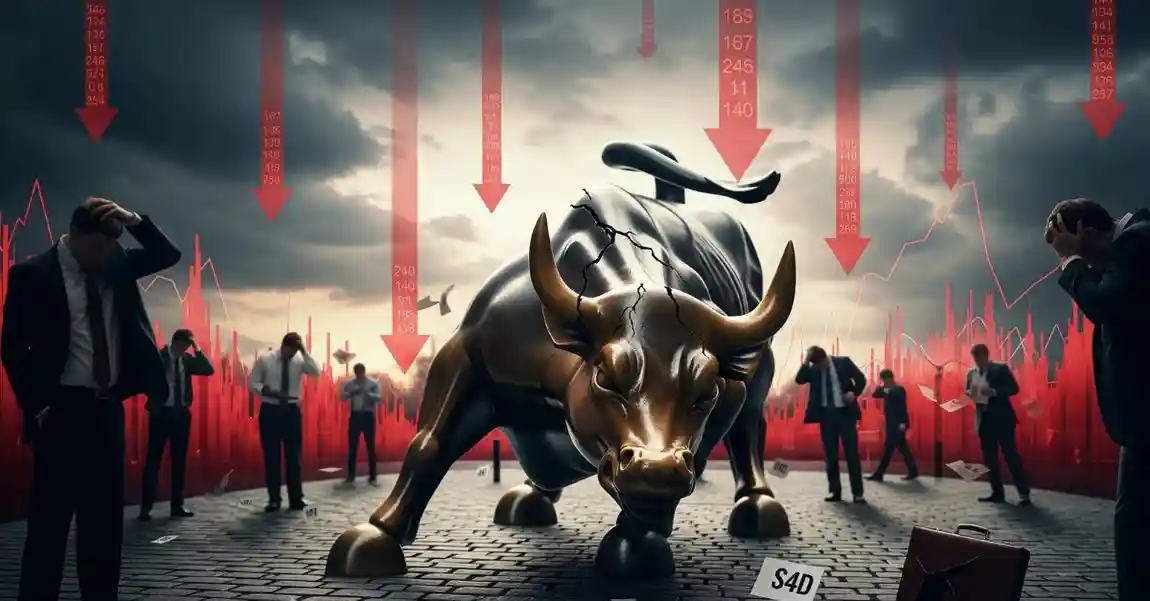
Wall Street Tumbles:- The U.S. stock market has been on a rollercoaster ride, with Wall Street Tumbles making headlines as the Dow, Nasdaq, and S&P 500 face significant declines. Investors are grappling with fears of economic uncertainty driven by surging Treasury bond yields and concerns over President Donald Trump’s tariff policies. These factors have sparked volatility, with the S&P 500 dropping into correction territory and the Nasdaq entering a bear market. Why are these market shifts happening, and what do they mean for investors? This article dives deep into the causes, impacts, and strategies to navigate this turbulent financial landscape, offering insights for both seasoned traders and everyday investors.
Wall Street Tumbles:- Understanding the Market Downturn
Contents
- 1 Wall Street Tumbles:- Understanding the Market Downturn
- 2 Impact on Investors and the Economy
- 3 Investor Strategies in a Volatile Market
- 4 Global Market Reactions
- 5 Trump’s Policy Pivot: A Temporary Relief?
- 6 FAQ Section
- 6.1 1. What Caused the Recent Wall Street Tumbles?
- 6.2 2. How Do Rising Bond Yields Impact the Stock Market?
- 6.3 3. What Are the Risks of Trump’s Tariff Policies?
- 6.4 4. How Can Investors Protect Their Portfolios During Market Volatility?
- 6.5 5. Are There Opportunities in a Bear Market?
- 6.6 6. What Should Investors Watch for in the Coming Months?
- 7 Conclusion
What Caused Wall Street Tumbles?
The recent market turmoil stems from two primary forces: rising Treasury bond yields and Trump’s aggressive tariff announcements. These events have created a perfect storm, shaking investor confidence and triggering sharp declines across major indices.
Surge in Treasury Bond Yields
Treasury yields, particularly the 10-year and 30-year notes, have spiked significantly. The 10-year Treasury yield jumped to 4.5% in April 2025, up from 3.9% earlier in the year, while the 30-year yield approached 5%, a level seen as a headwind for stocks. Rising yields reflect investor concerns about:
- U.S. Debt Levels: The U.S. government’s $36.2 trillion debt has raised fears of higher borrowing costs, especially with proposed tax cuts potentially adding $3–5 trillion to the deficit.
- Inflation Expectations: Tariffs are expected to increase consumer prices, pushing inflation projections to 6.7% for the year ahead, the highest since 1981.
- Bond Market Sell-Off: Investors selling U.S. Treasuries have driven yields up, signaling a shift away from traditional safe-haven assets.
Trump’s Tariff Policies
President Trump’s announcement of sweeping tariffs, dubbed “Liberation Day” tariffs, has rattled global markets. Key points include:
- Reciprocal Tariffs: A baseline 10% tariff on nearly all imports, with higher rates (up to 125% on Chinese goods) targeting specific countries.
- Global Retaliation: China responded with an 84% levy on U.S. products, escalating the trade war and threatening global supply chains.
- Economic Impact: Analysts from UBS and Goldman Sachs warn that tariffs could reduce U.S. GDP growth by 2% and push inflation to 5%, increasing the risk of a recession.
Market Performance: A Snapshot
The Dow, Nasdaq, and S&P 500 experienced significant losses, with some of the worst single-day drops since the 2020 COVID-19 crisis. Here’s a breakdown of the impact:
| Index | Peak Decline | Date | Percentage Drop |
|---|---|---|---|
| Dow Jones Industrial Average | 2,231 points | April 4, 2025 | 5.5% |
| S&P 500 | $5.06 trillion in market value | April 3–4, 2025 | 5.97% |
| Nasdaq Composite | 20% from December 2024 high | April 4, 2025 | 5.82% |
These declines reflect a broader market correction, with the S&P 500 down 12.17% from its February high and the Nasdaq in a bear market, down over 20%.
Impact on Investors and the Economy
How Tariffs Affect Companies and Consumers
Trump’s tariffs, designed to protect U.S. manufacturing, are likely to increase costs for American companies and consumers. Here’s how:
- Corporate Profits: Companies like Apple, Nike, and Best Buy, reliant on global supply chains, saw stock declines of 9.3%, 14.4%, and 17.8%, respectively, due to higher import costs.
- Consumer Prices: Economists predict a 2% increase in the Consumer Price Index (CPI), raising the cost of goods from electronics to clothing.
- Global Trade: Retaliatory tariffs from China, Japan, and South Korea threaten to disrupt trade, potentially leading to supply chain bottlenecks.
The Bond Market’s Role
The bond market’s reaction has been equally concerning. Rising yields indicate a sell-off in U.S. Treasuries, traditionally seen as safe havens. This shift suggests:
- Declining Confidence: Investors, including foreign entities like China holding $759 billion in U.S. bonds, may be losing faith in U.S. assets.
- Higher Borrowing Costs: Increased yields raise interest rates for mortgages, auto loans, and corporate borrowing, potentially slowing economic growth.
Case Study: Apple’s Stock Plunge
Apple, a tech giant heavily reliant on Chinese manufacturing, lost over $310 billion in market value in a single day on April 4, 2025. The company’s 9.3% stock drop was driven by fears that tariffs would increase production costs and reduce consumer demand due to higher prices. This example underscores the vulnerability of tech firms to trade policy changes.
Investor Strategies in a Volatile Market
Investors can take proactive steps to mitigate risks during this period of uncertainty. Consider the following strategies:
- Diversify Investments: Spread assets across sectors less exposed to tariffs, such as utilities or healthcare, which showed resilience in recent market data.
- Focus on Safe Havens: Gold prices surged to $3,160 per ounce, reflecting its appeal as a hedge against market volatility.
- Monitor Bond Yields: Keep an eye on Treasury yields, as further increases could signal deeper economic challenges.
- Long-Term Perspective: Historical data shows that bear markets, averaging 18.9 months, eventually recover. Low-cost index funds remain a solid long-term strategy.
Expert Insights
Analysts like Ed Yardeni and Laurence D. Fink have warned of prolonged volatility due to Trump’s trade policies. However, Morgan Stanley’s upgrade to an “overweight” stance on U.S. equities suggests that the global economy is still expanding, offering opportunities for cautious optimism.
Global Market Reactions
International Impact
The tariff-induced sell-off wasn’t limited to the U.S. Global markets also felt the heat:
- Europe: The STOXX 600 index dropped 5.12%, with Germany’s DAX and France’s CAC 40 falling 3% and 3.31%, respectively.
- Asia: Japan’s Nikkei 225 sank 2.75%, and Hong Kong’s Hang Seng lost 1.52%, reflecting fears of reduced U.S. demand.
Currency and Commodity Shifts
The U.S. dollar weakened, hitting a six-month low against major currencies, while gold prices soared as investors sought safety. Conversely, oil prices plummeted to $61.99 per barrel, signaling concerns about a slowing global economy.
Trump’s Policy Pivot: A Temporary Relief?
On April 9, 2025, Trump announced a 90-day pause on tariffs for most countries, except China, leading to a massive market rally. The S&P 500 surged 9.5%, its best day since 2008, and the Dow jumped nearly 3,000 points. However, analysts caution that:
- Uncertainty Persists: The pause is temporary, and no trade deals have been finalized.
- China Tensions: Tariffs on Chinese goods increased to 125%, keeping U.S.-China trade tensions high.
- Bond Market Volatility: Despite the rally, Treasury yields remained elevated, indicating ongoing investor concerns.
FAQ Section
1. What Caused the Recent Wall Street Tumbles?
The recent tumbles on Wall Street stem from a confluence of economic and policy-related factors. Rising U.S. Treasury bond yields, particularly the 10-year note reaching 4.8% in January 2025, have pressured stock valuations by increasing borrowing costs and making fixed-income assets more attractive. This shift was triggered by a stronger-than-expected jobs report, which reduced expectations for Federal Reserve rate cuts, signaling persistent inflation and a robust economy. Additionally, uncertainty surrounding President Trump’s tariff policies, announced in April 2025, has fueled investor concerns about potential trade disruptions and inflationary pressures.
A bond selloff, driven by fears of devalued fixed payments due to inflation, further exacerbated market volatility. The S&P 500 dipped 1.1% in late December 2024, reflecting these pressures. Geopolitical tensions and increased government debt also contributed, as investors reassessed risk amid a growing fiscal deficit and shifting trade dynamics. These factors combined to create a cautious market environment, prompting selloffs across major indices.
2. How Do Rising Bond Yields Impact the Stock Market?
Rising bond yields, such as the 10-year Treasury yield climbing to 4.8% in January 2025, significantly influence the stock market by altering investor behavior and asset valuations. As bond yields increase, fixed-income securities become more appealing compared to stocks, especially for risk-averse investors, leading to capital outflows from equities. This was evident in the recent bond selloff, which saw yields surge by half a percentage point in a week, the largest since 2021. Higher yields raise borrowing costs for companies, squeezing profit margins and potentially slowing growth, particularly for high-valuation tech stocks.
They also increase the discount rate used in stock valuation models, reducing the present value of future cash flows and pressuring stock prices. However, some analysts suggest that if yields rise due to strong economic performance, this could support corporate earnings, mitigating negative impacts. The CBOE Volatility Index (VIX) rose 26% in early January 2025, reflecting heightened market uncertainty driven by these dynamics.
3. What Are the Risks of Trump’s Tariff Policies?
President Trump’s tariff policies, including a 10% universal tariff and a temporary pause on higher tariffs announced in April 2025, introduce significant risks to the economy and markets. These policies could drive inflation by increasing the cost of imported goods, eroding consumer purchasing power and devaluing fixed-income assets like bonds. This concern contributed to the recent bond selloff, as investors feared inflation would reduce the real value of bond payments. Higher tariffs may also disrupt global supply chains, raising costs for businesses reliant on imports, which could compress corporate profit margins.
Retaliatory tariffs from trading partners could further harm U.S. exporters, potentially slowing economic growth. Analysts warn that these policies might exacerbate the U.S. fiscal deficit, already a concern with rising Treasury yields. If sustained, these risks could trigger a self-inflicted recession, as noted by some strategists. The uncertainty surrounding these policies has heightened market volatility, with investors closely monitoring trade negotiations and economic data.
4. How Can Investors Protect Their Portfolios During Market Volatility?
Protecting portfolios during market volatility requires a strategic approach to risk management. Diversification across asset classes, such as bonds, commodities, and defensive stocks (e.g., utilities or consumer staples), can reduce exposure to equity market swings. Bonds, despite recent selloffs, offer stability, with money market funds yielding 4.27% as of January 2025, providing safer returns than stocks. Hedging strategies, such as options or inverse ETFs, can offset potential losses. Maintaining a cash reserve allows investors to capitalize on market dips by buying undervalued assets.
Rebalancing portfolios to align with long-term goals prevents overexposure to volatile sectors. Gold and other safe-haven assets can act as a hedge against inflation, which is a concern amid rising bond yields and tariff policies. Staying informed about macroeconomic indicators, like inflation and Federal Reserve actions, helps anticipate market shifts. Consulting a financial advisor ensures tailored strategies, as volatility, reflected by the VIX at 20.72 in January 2025, demands proactive measures to safeguard investments.
5. Are There Opportunities in a Bear Market?
A bear market, characterized by a sustained decline in stock prices, presents unique opportunities for savvy investors. Lower valuations allow for purchasing high-quality stocks at discounted prices, particularly in sectors like technology or healthcare, which may rebound strongly during recovery. Dividend-paying stocks, often found in utilities or consumer goods, provide steady income streams during downturns. The recent market dip, with the S&P 500 falling 1.1% in December 2024, highlights potential entry points for long-term investors.
Fixed-income assets, such as Treasury bonds yielding 4.8%, offer attractive returns with lower risk compared to equities. Short-selling or inverse ETFs can capitalize on declining markets, though they carry higher risks. Dollar-cost averaging allows investors to spread out purchases, mitigating the impact of volatility. Additionally, sectors resilient to economic slowdowns, like healthcare, may outperform. Investors should focus on fundamentally strong companies with solid balance sheets, as these are likely to weather downturns and thrive in subsequent recoveries.
6. What Should Investors Watch for in the Coming Months?
In the coming months, investors should monitor several key factors influencing markets. Inflation data, including the Consumer Price Index (CPI) and Producer Price Index (PPI) releases, will signal whether price pressures from Trump’s tariff policies persist, potentially affecting bond yields and Federal Reserve policy. The Fed’s interest rate decisions, especially after the unexpected jobs report in January 2025, will be critical, as delayed rate cuts could sustain high Treasury yields. Trade policy developments, particularly tariff negotiations, will impact global supply chains and corporate earnings.
The U.S. fiscal deficit and government debt levels, which have driven recent bond selloffs, warrant close attention, as they could further elevate yields. Geopolitical tensions, particularly in oil-sensitive regions, may influence energy prices and inflation. Corporate earnings reports will provide insights into how companies are navigating higher borrowing costs and trade disruptions. Finally, the CBOE Volatility Index (VIX) and Treasury market liquidity will indicate ongoing market stability, guiding investment decisions.
Conclusion
The recent Wall Street Tumbles, driven by surging bond yields and Trump’s tariff policies, have created a challenging environment for investors. The Dow, Nasdaq, and S&P 500 have faced significant declines, with the S&P 500 losing $5.06 trillion in value over two days in April 2025. While a temporary tariff pause sparked a rally, uncertainty persists, with potential inflation, recession, and global trade disruptions looming. By diversifying portfolios, focusing on safe-haven assets, and staying informed, investors can navigate this volatility. Share your thoughts on these market shifts in the comments below, or sign up for our newsletter for the latest financial insights.